About Blow-Up
The impulse to categorise Michelangelo Antonioni’s Blow-Up (1966) as a film distinct from the Hollywood traditions is very tenacious, and not without good reasons. It is a film that had the backing of a major Hollywood Studio: MGM. It would therefore be challenging to compare Blow-Up against the Hollywood machine. Classic Hollywood Cinema, still rampant in the 60s despite a slow emergence of the American New Wave in conjunction with the era’s socio-political sea-change, can be characterised by the following tropes: causality, resolution and a character-driven narrative. One recalls the Aristotelian model for tragedy [1] as defined by way of a ‘representation of an action which is serious, complete, and of a certain magnitude.’ (Shepard and Wallis, 2004, p.167) The second criterion implies causality, and the first implies a certain accountability which can be pinned down within the diegesis, in cinematic context in this case. In fact the Aristotelian tropes are highly interlinked in their suggestion of each other: causality is a notion that is predicated on the presumption that there is meaning to be discerned (because logic is assumed to be the catalytic component prompting each step in the chain of events), thus every single gesture and speech must have a rationale behind. Henceforth, an action has already been presumed to be a logical, thought-through and thought-driven extension of character – the character has an interiority which governs the implementation of choice and hence action. The Aristotelian model would then negate meaninglessness as a possible rule of engagement – between characters and reality, and within the object-subject relationship that exists between the film and the audience; when placed side-by-side with film narratives told through conventional techniques, Blow-Up magnifies the tropes of an ever elusive meaning and reality as the basis of its own formulation, and since no discussion on the integrity of meaning can leave out the examination of character (as afore-mentioned), this essay shall be contending with issues of characterisation and its key roles in defining the themes of the film – that of displacement of the soul and alienation from one another and also within oneself. This sense of the ambiguity in meaning is also tied umbilically to the ever shifting, unstable ‘truths’ or ‘reality’ as presented on screen. The reality (filmic) that Antonioni constructs on screen is but a façade; we are made to be highly aware that we are constantly watching a surface, a film, a construct, and it is necessary to see beneath what is presented to us.
 Blow-Up is bracketed by the appearance of the merry-makers and this is an important sequence to note. We do not know who these people are exactly, and their elusiveness has led various critics to offer various readings [2] ranging from anarchists to university students participating in Rag Day. What is worth giving a thought to is that these figures are made-up in paints and fantastical raiment, consciously setting themselves apart from the other people and reality within the diegesis, as if they are protesting against their inclusion in a film rather than inhabiting the realm of a mime performance that they naturally belong to. To further widen and magnify this gap, Antonioni would in the opening sequence, intercut between them fooling around in high spirits along the streets with dour images of workers streaming out of the doss house. Metaphorically speaking, these figures act as signs or markers functioning as entry and exit points into Blow-Up’s unique filmic universe. Our perception of the film as a construct with its own peculiar workings is immediately alerted. As they suggest tropes of performativity distinct from the mode of conduct of everyday living, they semiotically fracture the film into differing ‘realities’ - the world where they inhabit versus the world where the rest of the characters inhabit. Thus, finding them in the same diegesis as the other characters does prompt the question of what constitute the basis of reality and character. And it is this spirit of questioning that runs through the film.
One is always aware of the directorial gaze of Antonioni. In Classic Hollywood Cinema, suturing being a priori, the gaze of the camera has to be non-intrusive as to allow for an alignment with the audience’s own gaze; the audience sees what the camera captures, and in such visual rapport the audience can partake in the narrative of the filmic universe. This is however not the case with Blow-Up. Consider two sequences: the first is where David Hemming’s character – Thomas, photographs the clandestine lovers in the park, and the second is where he returns to the park after the “weed-party” at the apartment. In the former instance, the camera gaze that frames the lovers are noticeably incongruent with the perspective of Thomas. While in the latter, Thomas looks up at the tree where he witnessed the dead body the night before, and this action is immediately cut to a low-angle shot of the canopy that ostensibly simulates his own gaze, but this observation is immediately refuted as the shot swings back to show his profile; the shot that initially establishes itself as the gaze of Thomas, hence belonging within the diegesis, turns out to have stemmed from an external presence.
This constant intrusion of the directorial gaze, or at least the suggestion of a presence external to the filmic universe, obviates the audience’s slant into the diegesis of Blow-Up and necessitates the viewing of the film as an overtly discursive object. This act of an highly participatory and active perception from the audience’s point of view suggest that the tropes of characterisation and reality in the film would have to be viewed differently from those of Classic Hollywood narrative.
It is of note that the audience do not learn the names of the characters [3]. Left without the most basic of signifiers, a barrier is extended between the audience and the figures they witness on the silver screen. Incidentally, with this sense of the audience being an entity distinct within its situation in a non-filmic universe, it foregrounds the awareness that those human figures moving about on the silver screen are indeed figments of celluloid imagination, they become carriers of meanings explicating the themes of the film. Once again, suturing is avoided, we are reminded of watching a constructed ‘reality’.
This sense of alienation confers an affective response on the audience’s part to downplay any inclination to view the characters in Blow-Up as capable of any interiority, much less roundedness. When perceived from this remove, it would be in tandem with one of the main themes of the film – that of displacement of the self. We can acutely sense that the characters are very much alienated from one another. As such, other signifiers, begin to surface in the film as the audience tries to circumvent an alternative understanding of the film, by looking out for a different set of markers.
Moments of characterisation become mere decorations of an inanimate soul. The close-up shot of David Hemming’s character toying with the coin in his fingers, and the long shot of him prancing up the hill in the park, are both rendered ineffectual as moments that can potentially establish him as a figure with an interiority; these moments stick out of the entire construct of the film like a sixth finger, simply because they become collectively disempowered by virtue of the fact that they seem so out of place in the context of the film – the slow, measured and almost meditatively pace of the film feels unable to house these sudden spurts of characterisation; these shots call attention to themselves but explication is always withheld. The film is always undermining itself as a universe that can harbour real substantial accountable human interactions, albeit celluloid in nature; suturing is thrown out of the window, together with the demands of resolution.
Because human interactions become ineffectualised in the film, the lack of causality needs no explication: how did Vanessa Redgrave’s character manage to locate the address of the photographer? And what exactly was Thomas squinting out of the window at the café where he had a short meet-up with his publisher? In fact, it is the utter lack of explication foregrounding an inchoate filmic universe that confers a reaction on the audience to see these figures on screen as emptied of substantial inner workings. Every action of the characters becomes mere gesture, having no veritable or apprehensible raison d’etre; without a weighted depth of cognitive processes that precede them, these gestures are mere reflexes of a mechanicised body – the characters become tools, objects with symbolic meanings operating within the diegesis.
Though it can be argued that Vanessa Redgrave’s character is driven by a motivation, which is to retrieve the incriminating photographs which Thomas has taken of her – hence the displays of agitation and desperation in the park, and her calculated seduction of the photographer back in his loft – her actions (and decidedly ‘spaced out’ and ‘trancelike’ acting) seem to be less the extensions of an inner psychological process than a series of idiosyncratic gestures puppeted by an external hand, clearly that of Antonioni. Redgrave’s character is indeed one of the most interesting in the film and demands further probing. Although she is set up for us to be one of the main lead (the entire mystery of the photos/murder hinged on her), we learnt almost nothing about her and after the main confrontational episode in Thomas’s loft, she disappears completely from the narrative, only to appear briefly later at the club, prompting Thomas to pursue. If anything, she subverts the conventional narrative arc and gravitas a main lead would have to possess in the story universe. Antonioni is seemingly not concerned with satisfying our curiosity with this character who is inextricably linked to the murder mystery. Thus she can be said to be less a character having an inner propulsion than a marionette willed into movements and speech as and when it is required. And the fact that Redgrave’s presence in the film is mostly re-represented through two-dimensional photography (itself calling into question the framing and re-constitution of reality) where she would undergo a series of ‘enlargement’ and ‘transformation’ in the hands of Thomas is indeed Antonioni’s slyest remark on perceptions, superficiality and reality.
A similar argument can be made for Hemming’s character. The psychologically and spiritually displaced audience at the underground punk-rock concert appears to be an externalisation of Thomas’s own displaced interior, despite his semblance of agitations as he pushes his way – as if he does not belong in that place. This explains why he held on to the shard of the broken guitar thrown to the audience (which suddenly become animated at the prospect of the catch) as if he believed in its preciousness, only to discard it at the exit of the club – ultimately it means nothing to him, though he still goes through the motion of protecting it.
An appendix to the notion of depersonalisation of characters could be made with the observation that, since the film has, in this light, become a discursive tract comprising a set of signs and signifiers, the figures of the white-frocked nuns, the merry-makers and the soldiers marching up and down street are all purely functional tropes fuelling the film’s preoccupation with a certain inanimation of the soul that has invaded the human condition and which, in the case of Blow-Up, is a defining condition of the Swinging London scene: the nuns and the soldier perhaps symbolising propriety and rules, and cutting across their path is the blazing trail of the merry-makers who are certainly embodiments of anarchic ideals. Of course, not forgetting deadened and expressionless audience at the punk-rock concert which is certainly an embodiment of the emotional, spiritual and psychologically wasteland that is within the characters of the film, accounting for their senseless actions and empty gestures.
This reading is certainly in tandem with the working philosophy of Antonioni:
“We know that beneath the represented image there is an other image more true to reality, and that beneath that one, still one more, and again a further image beneath that one, until you get to the true image of reality, absolute, mysterious, that no one shall ever see. Or perhaps, one will arrive at the decomposition of any image whatsoever, of any reality whatsoever”. (Rohdie, 1990, p.155)
Antonioni is wary of the certitude which most is inclined to assume in hermeneutics, and it is this certitude that he wishes to fracture. Thus not only the ever-shifting sense of reality that one gets in watching his films – as demonstrated by the key scene in which Thomas continually blows up the photos and discover hidden truths – Antonioni also adopts a highly rigorous method in the composition of his frames which foregrounds the very constructed-ness of the mis-en-scene: from the placement of the objects and the selection of the palette to the gradation or the lack-of in lighting, such tightly controlled visual composition is an excellent foil to the ambiguity belied by the storyline of the film. And it is this awareness of the incongruence between the “perfected” placement of objects or colours in the frames and the loosely structured, if not wandering narrative of Blow-Up which points us to the fact of the mis-en-scene being highly constructed – the “perfection” of the visual composition is illusory. The reality that we experience on screen is but a carefully manipulated construction, we are therefore pushed to pursue beyond this artifice to search for the ‘true image of reality’.
Blow-Up is an extremely self-reflexive film. This is very much done so through the intrusion of the directorial gaze as well as the sense that the characters are externally manipulated, as mentioned earlier. Antonioni once mentioned:
I worked a lot in Il deserto rosso with the zoom lens to try and get two-dimensional effects, to diminish the distances between people and objects, make them seem flattened against each other. This time [in Blow-Up…] I’ve tried to lengthen the perspective, to give the impression of space between people and things. (Chatman, 1985, p.153)
The adoption of this cinematography style is clearly a self-reflexive response to the nature of reality as presented, or captured, in two-dimension in the craft Thomas’s: photography. This lengthening of perspective, carried out by the predominating wide-angle shots emphasising the fact of intervening space, is itself an emphasis that reality itself can never be rendered upon a two-dimensional plane; reality can never be truly, accurately, nor absolutely captured within the flattened-out image representation in photography. This emphatic gesture is really an extension of the external directorial presence making itself known, insinuating itself within the diegesis of Blow-Up. It is this notion that calls into question Antonioni’s and our own position as a catcher of images: whether we can truly present in images an absolute truth in reality.
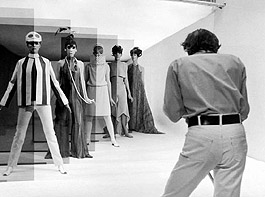
Perhaps feeding this point is the ambiguity of visual appearance in Blow-Up which is illustrated in many details: the transparent plastic panels behind which the models pose, blurring their position in space; the random splatter “action” style of Bill’s abstract paintings a la American abstract painter Jackson Pollock which suggest an acutely intuitive, irrational way of thinking; the neon sign above the park that is not quite in focus, and not quite comprehensible.
This idea of visual ambiguity is most clearly shown in the tour-de-force key scene where Thomas unwittingly blows up a segment of the photograph of Redgrave and her male companion in the park. What is initially seen as a lover’s afternoon tryst turns out to be, after multiple photographic enlargements, a case of a plotted murder. This unstable, ever shifting sense of reality and represented truth, even though as it is captured by the objective and mechanized camera eye is Antonioni’s most cogent and elegant way of discourse. For the first time perhaps, we the audience, are situated in the very same shoes of Thomas and are forced to question our own take of reality (that of the filmic universe, then extending onto ourselves) and the necessity to probe and uncover hidden truths.
Most importantly, the unexplained disappearance of Thomas at the end of the film marks the transcendence of the theme of visual ambiguity from the mere story to the very structure of the film’s discourse, contributing to the overt discursiveness of the film. We are knee jerked into questioning: has Thomas slipped into another reality – that of the merry makers, or is he but a figment of our imagination. Decidedly so, the ending of Blow-Up is one of Antonioni’s most powerful remarks on what we are really seeing and experiencing.
These visual elements prevent the audience to comfortably embrace the filmic universe of Antonioni– temporary suspension of disbelief is a term which can be by-passed when viewing Blow-Up: one does not have to believe anything in the diegesis as real. This is not the same as saying that the film is not a reflection of reality; reality is a function of reasoning, and each individual has his own syllogistic process. Blow-Up then becomes Antonioni’s own take of reality – we do not have to agree. This “disagreement” lays the foundation for viewing the film as discursive and paves the way for us to engage with issues beyond the film.
To watch Blow-Up is to be seated in the witness stand, where one is placed in a position to question the constitution of reality, and this constitution is often tied up with the need to locate meanings, or meaningful happenings, in the reality. At first glance, Blow-Up would present itself as utterly devoid of meaning as its constructs – the events, causality, the characters’ motivations, the unexplained – because its set-up is not a reality that a conventionalised audience can absorb as something that corresponds to their own vision (or interpretation) of reality. Reality is inchoate, complex, fraught with contradictions and deceptions in Antonioni’s universe, but nevertheless he urges us to push on, to continually seek with intelligence and a tireless mind, truths beyond our superficial selves.
Reference:
Arrowsmith, William (1995). Antonioni, The Poet of Images. Great Britain: Oxford University Press.
Chatman, Seymour (1985). Antonioni; or, The Surface of the World. Los Angeles: University of California Press.
Shepard, Simon and Wallis, Mick (2004). Drama/ Theatre/ Performance. London: Routledge.
Rohdie, Sam (1990). Antonioni. Great Britain: BFI Publishing.
http://www.imdb.com/title/tt0060176/
[1] This reference to tragedy does not presume that Blow-Up is configured as a tragedy. It is utilised with the historicism of dramaturgy in mind, chiefly the deconstruction of the nature of drama in ancient Greek times where the main component of their theatrical staple was the tragedies – not all dramas are tragedy. The reference is concerned solely with the nature and constitution of a dramatic action.
[2] As mentioned by Peter Brunette, American film historian, who did the commentary of Blow-Up DVD released in 2004 by Warner Home Video.
[3] A quick reference through IMDb will reveal that characters’ names have been written into the screenplay, though the names are never uttered in the course of the actual film, with the exception of Bill’s who is the painter of David Hemming’s character, and the husband of Sarah Miles’.
Written by: Willie Koh
|