Horror and surrealist traditions in the films of David Lynch
Introduction
David Lynch has often gently protested against well-meaning attempts by writers, journalists and academics to pigeonhole him and his works into any particular genre. The press kit for Lost Highway, for instance, is careful not to paint him as a horror or surrealist filmmaker, hinting only at his inclinations by printing his quote: “I love German expressionism and I love surrealism… but, I had never seen The Cabinet Of Dr. Caligari until after I had done Eraserhead” (“Lost Highway Press Kit”, 1997). Indeed, before making Eraserhead, he had hardly watched groundbreaking surrealist films like Un Chien Andalou or read up much on surrealism (Breskin, 1997, p 62). When it comes to horror, he seems equally ignorant. Other than Alfred Hitchcock mysteries like Vertigo and Rear Window, he rarely mentions mystery or horror films – particularly generic horror films – as having an impact on him, naming instead dark and unsettling human dramas like Lolita, Sunset Boulevard and Persona as among his favorites (Chion, 1995, pp 24-25).
But writers have not shied away from making references to his surrealist or horror tendencies. Charles Taylor of popular website salon.com writes that “surrealism is his natural language” ( Taylor, 2000). According to Marina Warner of Sight and Sound, Lynch has stated his affections for the writings of surrealist champion Andre Breton (Warner, 1997), who published the famous Manifesto of Surrealism – even though many books written on Lynch have been sparing in their use of the word “surrealism” when discussing his work. Meanwhile, Steven Jay Schneider, in his examination of Eraserhead, writes that Lynch does “rely upon formal and thematic techniques familiar within the horror genre… By highlighting Eraserhead’s debt to generic horror conventions, the conception of Lynch as an eccentric artiste working in a cinematic vacuum may be somewhat damaged”. (Schneider, 2004, pp 5-6)
This paper will attempt to analyze how Lynch does indeed use standard horror conventions as well as surrealistic “techniques”, so to speak, to create an atmosphere of dread, anxiety and mystery in his films. First, by using Paul Well’s brief but comprehensive 2000 book The Horror Genre: From Beelzebub To Blair Witch, comparisons will be made between the devices of generic horror films and Lynch’s oeuvre. Then, this paper will turn to the surrealist elements found in Lynch’s work and compare them with the writings and images of the surrealists.
Using horror traditions to generate anxiety
In The Horror Genre: From Beelzebub To Blair Witch, Paul Wells states that the “history of horror is the history of anxiety” experienced by society. Horror flourishes during historical times of hardships and chaos because it allows audiences to identify a “monster” that’s “responsible” for their misery. Wells lists the following four ideas as key themes in horror: “(1) social alienation, (2) the collapse of the spiritual and moral order, (3) a deep crisis of evolutionary identity and (4) the overt articulation of mankind’s innermost imperatives” (Wells, 2000, p 6) Surveying the list, it is not far-fetched to say that every one of Lynch’s films, from Eraserhead to Mulholland Drive, contains one or more of these themes.
Social alienation, the first theme, is a major preoccupation in Lynch’s films. In his most recent film Mulholland Drive, social alienation is what drives emotionally-volatile lesbian struggling actress Diane (Naomi Watts) to hallucinate the first two-thirds of the events in the film. The desperate realization that she will never be as talented or successful as her girlfriend Camilla (Laura Elena Harring), who is about to leave her and marry a hotshot male director (Justin Theroux), gives rise to painful dinner scene taking place at his house where Diane becomes the object of pointed condescension by the dinner guests.
The theme of social alienation also echoes in other works like Blue Velvet, Lost Highway, Twin Peaks (the series and film) and most obviously, The Elephant Man. In each of these films or TV series, the characters have a physical or psychological defect – such as facial and/or body disfigurements, penile impotency or a sexual fetish – that makes them feel disconnected from the larger society and sometimes drives them to commit violence.
 The second item on Wells list, the “collapse of spiritual and moral order”, is a recurrent theme in horror films. The Exorcist, Rosemary’s Baby as well as countless zombie films by George A. Romero often depict the perilous battlefield where “good” and “evil” fight. A very graphical representation of this “collapse” appears in his feature-length debut Eraserhead. Henry Spencer (John Nance) has illicit sex with his girlfriend Mary (Charlotte Stewart), and the birth of a grotesquely deformed baby who cries incessantly may be interpreted as punishment for committing premarital sex. When Henry commits an even bigger sin by killing the baby, the entire Planet explodes – even as the Man In The Planet pulls levers in an effort to save the Planet.
The collapse of order and establishment is also explored in Twin Peaks, when a quiet town is rocked by the murder of golden girl Laura Palmer and the FBI investigation, which would consequently reveal layers of sex scandals and improprieties. Similarly, in Blue Velvet, the finding of a severed ear in a picture-perfect suburban town would lead Jeffrey (Kyle MacLachlan) to more shocking discoveries of sex and violence. Blue Velvet’s much-praised opening sequence that finishes with the image of hungry insects teeming under a beautiful green lawn perfectly encapsulates the notion of evil seething beneath every peaceful town or city.
Here, it is useful to introduce Wells’ point that the horror film has often evolved directly in response to popular social, scientific and philosophical thought. The Marxist ideology of the late 19 th century gave rise to horror films featuring “the ‘monster’ of the alienated and the disadvantaged as the key protagonist against bourgeois middle-class orthodoxies.” (Wells, 2000, p 4) Classic horror films dating all the way back to Nosferatu (1922), to more recent offerings like Halloween (1978) and The House Of Wax (2005), often depict how society’s outcasts, rejected by the mainstream, exact their revenge. Whether or not Lynch is conscious of his influences, his small-town satires like Blue Velvet and Twin Peaks seem to have their roots here in this classic horror convention.
Similarly, the philosophical writings of Friedrich Nietzsche also form an important cornerstone of horror films. Nietzsche believed that man is entirely nihilistic and the universe is amoral, experiencing one conflict and confrontation after another. Wells argues: “(Nietzsche’s nihilistic stance) may be the fundamental theme of the horror film – in which the ‘monster’… represents the archetypal struggle, not merely between ‘good’ and ‘evil’, but for the presence of an ‘order’ which seeks to evidence and maintain the idea that there is someone or something to believe in which justifies material existence.” (Wells, 2000, p 5) Once again, it would be appropriate to suggest that Lynch’s films adhere closely to these ideas. From Fred (Bill Pullman) the schizophrenic murderer in Lost Highway to Lula (Laura Dern) and Sailor (Nicolas Cage) in Wild At Heart and, to some degree, Laura Palmer (Sheryl Lee) in Twin Peaks, these individuals are shown to be capable of amoral and nihilistic conduct.
The third common theme of horror films listed by Wells – “a deep crisis in evolutionary identity” – is also a recurrent theme in Lynch’s oeuvre. In Lost Highway, Fred ( Pullman) the musician suffers from impotency. In an effort to deny his shortcoming, he “reinvents” his identity as a virile young car mechanic Pete (Balthazar Getty) who, in the words of one character, “gets more pussy than a toilet seat”. When Fred murders his beautiful wife (Patricia Arquette), he imagines her resurrected as a sexy gangster’s moll who risks all just to be with Pete. In the final scene of the film, where Fred is being chased by the police for the murder, his face goes through a series of contortions – as if confused by his multiple identities.
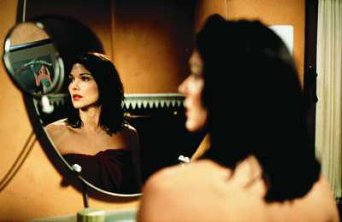 Likewise, Mulholland Drive also examines the crisis of identities when the hapless Diane (Watts) tries to deny her lover’s betrayal by imagining herself as a beautiful and gifted actress named Betty who helps an amnesiac woman Rita (Harring) get back on her feet. In the movie version of Twin Peak: Fire Walk With Me, Laura Palmer (Lee) also imagines the man who sexually abuses her as a thin, mean-looking man with long gray hair. But in one revealing sequence, she finally sees him as he really is – her own father Leland (Ray Wise). In the TV series version of Twin Peaks, FBI Agent Cooper (Kyle MacLachlan) dreams of entering The Red Room and meeting Laura Palmer’s twin who speaks backwards.
It should be noted here that the concept of dual or multiple identities, doppelgangers and spirit doubles is an important motif in the horror genre (Wells, 2000, p 8). The notion that there are two sides to an individual – one rational and the other primal – goes as far back as Robert Louis Stevenson’s 1886 novel The Strange Case Of Dr Jekyll & Mr Hyde and Bram Stroker’s 1897 novel Dracula – possibly even further. Hence, Lynch’s frequent use of this horror motif is hardly original.
The fourth significant theme to be found in horror films, as listed by Wells above, is “the overt articulation of mankind’s innermost imperatives”. Wells notes that Freud’s psychoanalytical theories of the id, ego and super-ego have had a tremendous influence on horror films: “Freud’s investigation of the structures of consciousness reveals a more ‘primal’ existence (or id) beneath the observable codes of socialized behavior. He suggested that repressed and unaddressed feelings are at the heart of unconscious thoughts, and that dreams often reveal meanings of the true nature of human identity.” The ‘monster’, according to Freud, can all be in the mind. (Wells, 2000, p 6)
Without a doubt, Lynch borrows liberally from Freud’s psychoanalytic theories. His narratives in Mulholland Drive and Lost Highway are founded on the ideas of repressed thoughts and subconscious desires. Parts of the narratives seem to have been hallucinated by Diane (Watts) and Fred ( Pullman) respectively. It is by no accident, then, that the narratives often lapse into dream-like sequences. Some of Lynch’s most bizarre characters, such as Blue Velvet’s masochistic Dorothy (Isabella Rossellini) and the insane Frank (Hopper), as well as Wild At Heart’s outrageously violent and immature Lula (Dern) and Sailor (Cage), are who they are because they are acting on their most primal instincts.
Pornography, prostitution and other sexual deviances, featured in many of Lynch’s films, may be argued to be mere expressions of man’s most basic instincts – what Freud calls the id, which works purely on the pleasure principle. When Jeffrey (MacLachlan) watches in morbid fascination the sexual perversions of Dorothy (Rossellini) and Frank (Hopper), only to allow himself to be seduced by Dorothy and mimic those perversions, we are surely watching his id at work. Wells writes: “The frisson of the horror text for the audience is underpinned by the expressed desire to experience feelings which relate to taboo agendas and the limits of gratification.” (Wells, 2000, p 21) Lynch certainly knows how to manipulate our sense of guilt and anxiety towards taboo subjects.
Indeed, an extremely important post-Freudian approach to dissecting horror films can be found in Julia Kristeva’s 1982 paper Powers Of Horror: An Essay On Abjection, also cited by Wells. Kristeva posits that: “Instead of having a fully-formed, highly ‘familiarized’ mature ego (which Freud perceives as the ideal state)… the human subject has a fragmentary unstable ego which is always partially formed. This unstable ego is fundamentally undermined by the recognition of the consistent collapse of the perceived ideal because of a detrimental repulsion to the functional aspects of the body. Bodily emission, waste and malfunction – the most evidently ‘taboo’ aspects of the body – become evidence of humankind’s perpetual decay, and operate as persistent signifiers of eventual death.” (Wells, 2000, p 16)
Manipulating of our visual and tactile revulsion towards rotting organs and diseased/decaying bodies – such as the severed ear in Blue Velvet, and the diseased baby and the stringy sperm-like objects in Eraserhead – is commonly used by Lynch to tap into our deep-seated anxieties about our own mortality. In this respect, Lynch is no different from generic horror filmmakers of slasher flicks who use extreme images of blood and gore to unnerve viewers.
Surrealist inclinations
It is impossible to say whether Lynch does or does not abide by surrealist traditions. To begin with, the surrealists championed arbitrariness. In the Manifesto of Surrealism, Andre Breton called for the “imagination which knows no bounds (to be) henceforth allowed to be exercised only in strict accordance with the laws of an arbitrary utility.” (Breton, 1924) Jean Goudal writes in “Surrealism and cinema” that “the artist’s principal target is henceforth to search for a reality in the dream superior to that which the logical exercise of thought suggests to us… (surrealism is), in short , the absolute overthrow of all values.” (Goudal, 1925, p 85).
Lynch’s images, however, are not entirely arbitrary. As Nicholas Rombes points out, Lynch’s works bears “a striking resemblance” to the works of avant-garde filmmaker Maya Deren, who use surrealistic images to explore concepts of gender, identity and sexuality, among others. Deren’s films blend elements of classical narrative with formally abstract, disorienting sequences. In her Meshes Of The Afternoon, a continuity-based narrative sequence that had her following a robed figure displays elements of a generic detective story. Meanwhile, the segment where she confronts two versions of herself in the mirror echoes the doppelganger motif in horror texts. Rombes notes: “Whereas Deren’s films are self-conscious avant-garde texts, Lynch’s films nest their experimentalism in more traditional Hollywood narrative conventions.” (Rombes, 2004, p 71)
Lynch’s “surrealistic language” (to paraphrase Charles Taylor) is also not entirely original. Schneider points out how Lynch’s use of certain devices to create a sense of “uncanniness” has its roots in the history of cinema. For instance, in Eraserhead, when Henry (Nance) goes to Mary’s (Charlotte Stewart) house for dinner, there is a segment where Henry sits for a long time at the table alone while her father (Allen Joseph) just stares at him – with a perfectly motionless body and a frozen smile. In the background, we can see Mary crying. According to Schneider, this strange juxtaposition of the animate and inanimate, and the “confusion over the ontological status of a particular individual – is s/he awake or asleep, conscious or unconscious, dead or alive – can be found in such a diverse collection of horror films as Mystery of the Wax Museum (1933), I Walked With A Zombie (1943), House Of Wax (1953), A Bucket Of Blood (1959)…” (Schneider, 2004, p 11)
A true surrealist, like Salvador Dali and Bunuel, would resist trying to create images that bore such an obvious relation to each other. Seeing as how Lynch’s films sometimes play like Chinese puzzles that can be unlocked using the right keys, maybe the term “surrealist” cannot be fully applied on Lynch – despite the fact that certain writers and academics have attached the term to him.
Conclusion
Whether or not Lynch actually borrows, or is aware of, or would admit to borrowing the technical conventions of various forms of filmmaking, it is no doubt that he is a master technician who can execute these conventions to create a feeling of strangeness, anxiety and paranoia in his works. It should also be noted that Lynch does not simply draw upon existing traditions of horror and surrealism. His films are often a pastiche of styles and conventions from other genres. For instance, Sight And Sound states that Blue Velvet draws elements of “teenage mysteries, porn films, coming-of-age movies, Capra-style family comedies, film noirs, Hitchcockian psychosexual thrillers and horror movies” (Sight And Sound, Winter 1986/87). Likewise, one could argue that Mulholland Drive widely draws its inspiration from detective stories, psychosexual thrillers, lesbian pornography, daytime soap operas, Doris Day comedies, beauty pageants and Hollywood satires.
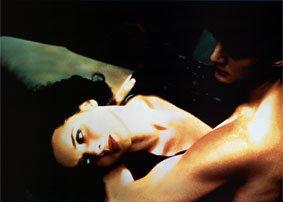 Arguably, the best horror films have something concrete to say about contemporary society and the conditions of existence (Wells, 2000, p 20). One instance of this is the vampire films The Lost Boys (1987) and Near Dark (1987), which reflected the anxieties the world felt about AIDS then. Lynch does not fail in this regard. Though not all his films can be placed in a broader social context, some of his finest works certainly have made profound statements about contemporary culture. Blue Velvet exposed the underbelly and hypocrisies of suburban America in the 1980s, Lost Highway explored the malleability of human identity in the age of Internet and recreational drugs, while Mulholland Drive could be read as a statement on the illusions of Hollywood glamour, beauty and sexuality.
Consciously or not, Lynch does rely on traditional motifs and conventions to create a sense of mystery and strangeness. But as 19 th century Gothic novelist Ann Radcliffe suggests: “Terror and horror are so far opposite, that the first expands the souls and awakens the faculties to a high degree of life; while the other contracts, freezes and nearly annihilates them.” (Wells, 2000, p 11) There’s no question as to which emotional state Lynch puts his viewers in. As Lynch himself said, in reference to his own films: “You have to solve the mystery and still leave room to dream.” (Rafferty, 2002)
Written By: Helmi Yusof
Bibliography
Books:
Breskin, David. Inner Views: Filmmakers In Conversation. New York: Da Capo Press, 1997.
Chion, Michael. David Lynch. London: British Film Institute, 1995.
Goudal, Jean. “Surrealism and cinema” (1925). In Paul Hammond (ed), The Shadow And Its Shadow: Surrealist Writings In Cinema, (pp 84–94). London: British Film Institute, 2000.
Rodley, Chris (ed). Lynch On Lynch. London: Faber & Faber, 1999.
Rombes, Nicholas. “Blue Velvet Underground: David Lynch’s Post-Punk Poetics” In Erica Sheen & Annette Davison (eds), The Cinema Of David Lynch: American Dream, Nightmare Visions, (pp 61–76). London: Wallflower Press, 2004.
Schneider, Steven Jay. “The Essential Evil In/Of Eraserhead (Or, Lynch To The Contrary)” In Erica Sheen & Annette Davison (eds), The Cinema Of David Lynch: American Dream, Nightmare Visions, (pp 5–18). London: Wallflower Press, 2004.
Wells, Paul. The Horror Genre: From Beelzebub To Blair Witch. London: Wallflower Press, 2000.
Newspaper and magazine articles:
Rafferty, Terence. “In A Weird Way, David Lynch makes sense” The New York Times , 10 Mar 2002.
Warner, Marina. “ Voodoo Road”, Sight & Sound, August 1997.
“Out of The Blue (review of Blue Velvet)”, Sight & Sound, Winter 1986/7.
Website articles:
Breton, Andre. “Manifesto of Surrealism”, 1924. Available online at http://www.tcf.ua.edu/Classes/Jbutler/T340/SurManifesto/
ManifestoOfSurrealism.htm
Taylor, Charles. “DVD review: Blue Velvet”, salon.com, 27 Jun 2000. Link: http://archive.salon.com/ent/movies/dvd//review/2000/06/27/
blue_velvet/index.html?CP=IMD&DN=110
Author unknown. “Lost Highway Press Kit”, 1997. Link: http://www.lynchnet.com/lh/lhpress.html |